
For patients facing a cancer diagnosis, “should I get treated abroad?” is rarely an easy question — and it shouldn’t be answered with marketing claims. So here’s the direct version: on population-level clinical outcomes, Korea does not lag behind the United States. On cost, the two countries aren’t close — US cancer treatment routinely runs several times higher than what international patients pay in Korea, even before US insurance gaps are factored in. This guide walks through the data behind both of those claims — starting with the cost of cancer treatment in Korea compared to the US.
Survival Outcomes: A Closer Comparison Than Most Blogs Admit
Korea’s National Cancer Center tracks 5-year relative survival through the national cancer registry — one of the most complete population-based cancer registries in the world, covering essentially all diagnosed cases nationally rather than a sample. For patients diagnosed between 2019 and 2023, the overall 5-year relative survival rate was 73.7%, and 92.7% for cancers caught at a localized stage. This figure has risen sharply over time — up from 54.2% for patients diagnosed between 2001 and 2005, largely due to expanded national screening programs for stomach, colorectal, and breast cancer.
In the United States, the equivalent measure comes from the National Cancer Institute’s SEER program. The most recent comprehensive report puts the overall 5-year relative survival rate for all cancers combined at approximately 70%, with wide variation by cancer type — from around 98% for thyroid and prostate cancer down to roughly 22% for pancreatic and liver cancer.
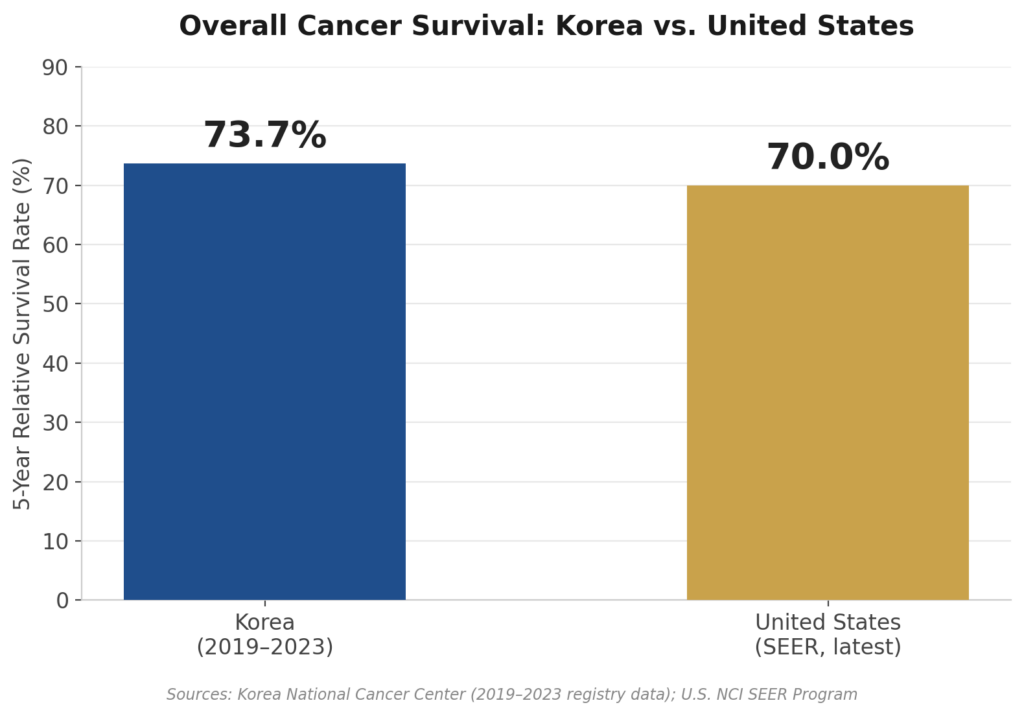
The honest comparison: these two national figures — 73.7% for Korea, roughly 70% for the US — are close enough that population-level differences in screening rates, average age at diagnosis, and the specific mix of cancer types diagnosed in each country likely explain more of the gap than any difference in treatment quality. Neither registry claims to prove one country’s oncologists are “better” than the other’s. What the Korean figures do demonstrate clearly is that national screening participation (now over 70–77% for stomach, colorectal, and breast cancer, up from under 40% two decades ago) has been the single biggest driver of Korea’s improvement — a point worth knowing if you’re deciding between getting screened locally versus during a Korea visit.
For specific cancer types, Korea’s data shows particularly strong outcomes for cancers with mature national screening programs. Stomach cancer 5-year survival reached 78.4% for patients diagnosed 2018–2022, and colorectal cancer reached 75.6% for 2019–2023 — both substantially higher than two decades earlier, reflecting more cases caught at a localized, treatable stage.
The Cost of Cancer Treatment in Korea vs. the US: Where the Real Gap Is
This is where the comparison stops being close. The real cost of cancer treatment in Korea depends on separating list prices from what patients actually pay.
United States (total treatment cost, not just out-of-pocket):
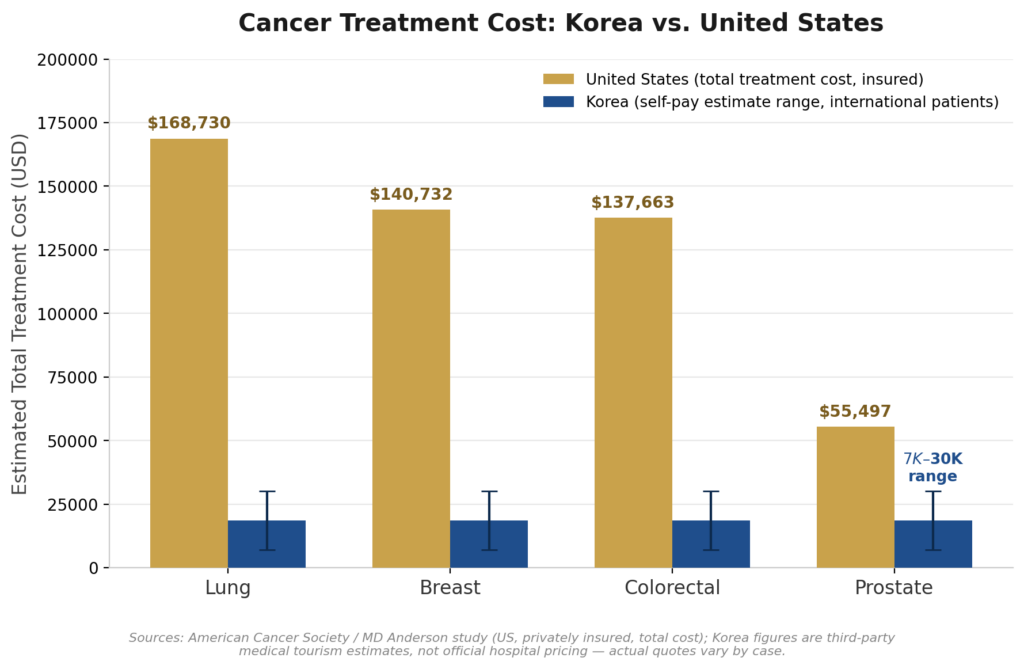
A 2022 American Cancer Society and MD Anderson study tracked privately insured, non-elderly patients. Mean total treatment costs (surgery, IV systemic therapy, and radiation combined) reached $140,732 for breast cancer, $168,730 for lung cancer, $137,663 for colorectal cancer, and $55,497 for prostate cancer by 2016 — figures that have continued rising since.
Even insured patients routinely face $6,000–$10,000 in annual out-of-pocket costs on top of what insurance covers, and uninsured patients can face bills exceeding $150,000.
Korea (self-pay, international patient rates):
Korea doesn’t extend its National Health Insurance subsidy to most international patients. That means the prices quoted to foreign patients are closer to full market rates — but still substantially below US totals.
Medical tourism facilitators report chemotherapy course estimates in the roughly $2,800–$8,500 range per treatment course, and total cancer treatment estimates (diagnosis through a full treatment course) commonly cited in the $7,000–$30,000 range depending on cancer type and stage. These figures come from third-party medical tourism sources, not official hospital price lists, so treat them as a rough sense of scale rather than a quote. The number that should actually guide a decision is the individualized estimate a Big 5 hospital’s international center provides after reviewing a patient’s real pathology report and imaging — every serious inquiry should start there.
Why the gap exists:
Korea’s lower baseline healthcare costs, government-regulated hospital fee structures (which apply to domestic and to a meaningful degree self-pay international pricing), and a National Health Insurance system that keeps overall market prices lower than the US’s largely privately negotiated system are the primary drivers — not lower-quality care or corner-cutting.
Technology and Specialization
Cost and survival statistics only tell part of the story — what a hospital is equipped to actually do matters just as much. Korea’s Big 5 hospitals have invested heavily in cancer-relevant technology. This includes Da Vinci robotic surgical systems (Korea has one of the highest robotic surgery adoption rates in Asia), CyberKnife and proton beam radiation therapy, and heavy ion therapy — a treatment still unavailable at most cancer centers worldwide. Severance Hospital introduced Korea’s first heavy ion therapy in 2023, and as of mid-2026 all three of its treatment rooms are running at full capacity, which is expected to shorten what had been wait times of up to six months. Seoul National University Hospital and Asan Medical Center are both now building their own heavy ion centers, with Asan targeting 2031 — a sign of how central this technology has become to Korea’s cancer treatment roadmap. Asan Medical Center was also ranked 25th among the world’s best hospitals overall and 5th among the world’s best specialized cancer hospitals by Newsweek’s 2025 rankings, reflecting international recognition specifically in oncology.
For patients with rarer or advanced-stage cancers, this technology access can matter more than the topline survival percentage: a treatment option that isn’t available at all is a bigger gap than a few percentage points of population-level survival difference.
Access: The Factor That Doesn’t Show Up in Either Country’s Statistics
US patients — even insured ones — frequently face weeks-long waits for specialist oncology appointments and surgical scheduling, particularly outside major metro areas. Korea’s Big 5 hospitals are built around high patient volume and centralized international patient centers. They’re generally able to move from initial consultation to treatment plan considerably faster once records are submitted — though exact timelines depend on cancer type, stage, and whether additional diagnostic workup is needed.
This is genuinely one of the most underappreciated factors in a cancer treatment decision: for aggressive or advanced-stage cancers, time from diagnosis to treatment start can matter clinically, not just logistically.
What This Means for Your Decision
The cost of cancer treatment in Korea is where this comparison stops being close from the data — here’s the clear-cut picture:
- On population-level outcomes, Korea does not lag behind the US — the two countries’ national survival figures are close enough that outcome quality alone doesn’t justify a large cost gap.
- On cost, the gap is real and substantial. US total treatment costs commonly run into six figures even for insured patients, while Korea’s self-pay international rates land at a fraction of that.
- On technology access, Korea’s Big 5 hospitals offer the same advanced treatment modalities available at leading US cancer centers, with faster access to some — heavy ion therapy being the clearest current example.
- On timeline, Korea’s high-volume, internationally-oriented hospital model often means faster movement from diagnosis to treatment start than many patients experience in the US system.
Put together: comparable outcomes, meaningfully lower cost, and equal or better access to the latest treatment technology is a hard combination to find anywhere else.
The right next step for anyone seriously considering this isn’t a blog comparison — it’s sending your actual pathology report and imaging to a Big 5 hospital’s international center for a real, personalized treatment plan and cost estimate. That’s the number that should drive the decision, not a national average.

A Note on This Guide
Cancer treatment decisions are highly individual, and national statistics — however well-sourced — can’t substitute for a review of your specific diagnosis, stage, and medical history by a qualified oncologist. This guide is intended to help you evaluate the general landscape, not to replace medical advice. If you’re currently facing a cancer diagnosis and weighing where to seek treatment, we’d encourage speaking with an oncologist in your home country alongside any international consultation you pursue.
If you’d like to understand how Korea’s Big 5 hospitals compare to each other for cancer care specifically, see our Big 5 hospital comparison guide, or explore individual hospital guides for Asan Medical Center and Severance Hospital, both recognized specifically for oncology care.